

There are, essentially, three weeks left in the WNBA season, if you count only the 22 game days remaining and disregard the FIBA World Cup break from August 31 to September 16. Most teams have already played 75% of their schedule. The eight playoff teams are just about locked in.
The excitement, however, is only ramping up, and with that in mind we’re going to carry over from last week and do a Monday Morning Point Guard slightly out of the ordinary. This week’s iteration cares, in all honesty, mostly about the playoff teams. To that end, I wanted to draw out one particular theme from the two exciting playoff team matchups from the weekend (Lynx-Aces and Fever-Dream) while going through the league in full standings order.
Let’s dive in. You’ll want to open this post in Substack since it will likely be truncated by your email client.
Minnesota Lynx 92, Las Vegas Aces 87 (Saturday night)
It was a Saturday night show in Sin City—or perhaps we should call it a spectacle. Minnesota won again in a clash of two of the league’s best, shooting 50% from the field, 42% from deep, and 94% from the free throw line to offset 32 points from A’ja Wilson. While everyone expects, with reason, to see this matchup again in the postseason, the Lynx won the season series 2-1 and lost by only three in a game that Napheesa Collier didn’t play (she appeared in both Lynx wins).
This game wasn’t about MVP narratives. It was about the Lynx picking on NaLyssa Smith. I hand-tracked every halfcourt defensive possession with Smith on the floor, and this is surely something the Aces will have to solve should these two teams meet again. Minnesota scored 1.23 points per possession in which Smith was involved in the action (be it guarding ball, backend of the ball screen, or an attack in her zone), much stronger than the 0.44 PPP they posted when Smith was on-court but uninvolved.
Las Vegas put Smith on Natasha Howard, with Wilson on Collier, and had Smith hedge Olivia Miles pick-and-rolls (even as the second defender in 77 actions, which the Aces don’t universally do).
When it had the intended effect of speeding Miles up, it did force turnovers on errant passes or deflections. When Miles played patiently, Smith and the Aces were unable to recover out of the 3-on-4 disadvantage, and Miles picked them apart, as you begin to see with the elite read in the last clip above (the Aces try a four-player rotation but Courtney Williams smartly sneaks in behind the rotation).
Miles’ ability to dot those hedge recoveries is ultimately what forced Las Vegas out of the coverage; overall, the Aces conceded 1.08 PPP on 13 possessions involving a Smith hedge.
You can see the discordance, I think: in the first clip, Smith and Chelsea Gray have two on the ball, leaving a 4-on-3 for Minnesota with Howard’s quick slip, which Wilson takes, which opens up the corner pass to Coffey (Jackie Young tries to gap that in a perfect world, but she’s guarding Kayla McBride!). Then—this is what forced Las Vegas’ hand—it’s more of a hedge and plug from Smith and Mai Yamamoto, but Turner drops from the wing (it is a 5’5 plug), and Smith isn’t rotating to Collier, who hits the wide open three.
Unfortunately, the next move was switching the first screen, which didn’t work against Miles’ shooting to start the game (to be fair, you live with something) and then really didn’t work against Miles’ isolation drives to end the game. The Lynx scored 10 points on seven possessions involving a Smith switch.
So the Aces went to Stephanie Talbot at the 4, in Smith’s place, which is a salve defensively but not necessarily sustainable for long stretches because of how dominant Smith is offensively for the Aces (seriously: I don’t know that there’s anyone better around the rim this year for on- and off-ball offense).
The question is, what do you do? The Lynx are second in the league in offense (113.9 ORTG) for a reason. They are a perfectly spaced team; there’s no starter for Smith to hide on, as the New York Liberty did with Jonquel Jones on Nia Coffey when Collier was out. In six possessions of drop coverage, Smith held up fairly well, but can you live with that against Minnesota (Smith did jump up to contest the one McBride ballscreen she defended)? It’s difficult to pre-switch against a team that runs so many drag screens and delay actions, but it could be intriguing when Minnesota isn’t at peak shot-making. Switching matchups probably might dig more holes than it fills (Wilson ranks 29th of 31 players who have been the backend in at least 200 direct PnRs this year, per Nekias Duncan), but it’s probably a tweak we’d see at some point.
On the plus side, there are correctable things: better point of attack defense no matter the coverage, recovering with more alacrity and communication, and simply playing better. The Lynx looked comfortable simply entering the ball to Howard in the post, too, and Smith lost her in zone and man apiece, but attention can be marshalled more frequently. Smith looked at her best when presented with the opportunity to go make a play in help. There could be plenty of help necessary in a potential playoff matchup between these two powerhouses.
Let’s talk playoff teams.
1. Minnesota Lynx (29-7, +10.5 NRTG - #1)
We just extolled the virtues of the Lynx offense indirectly, but here are two small examples of how Minnesota weaponizes McBride’s gravity.
In the first, the Lynx go to a ghost screen out of horns. McBride’s defender, Talbot, can’t afford to leave her, so she can’t help on the drive, of which the ghost screen already helps dictate the leverage (Jackie Young gets a step behind).
Then, because McBride is the new weakside wing, Talbot is already trailing her and not in a position to help Wilson, the low helper, on the drive, which leaves Collier wide open in the corner.
Second, on an ATO, the Lynx go five-out, and floppy for McBride forces a switch. The Lynx set it up so that the second defender (the one forced to switch) is a big, which gets Collier a turnaround mismatch in the post, where she draws a shooting foul.
2. Golden State Valkyries (24-0, +8.7 NRTG - #2)
I can’t wait for the Valkyries-Lynx marquee matchup on Wednesday night, which will get full post-game analysis, so I’ll have to tide myself over but showing what the Valkyries did to Kamilla Cardoso in a win over Chicago last week. If you want more on their defense, Eric Apricot has a video on a first-quarter defensive adjustment from that game, which you can find here.
I’ve spent a lot of time watching the Sky’s pick-and-roll defense lately, and presumably so has Golden State. Chicago is a very heavy “ice” team whose point-of-attack defense is its strength. Watch what Gabby Williams does to Kamilla Cardoso on the backend:
Snaking the screen at her leisure, Williams got to the line and got two buckets as easily as you might want. Well, almost as easily as Tip Hayes, who also torched Chicago the exact same way.
Chicago switched to a more up-to-touch coverage from Cardoso, specifically denying the snake, with some effect, but a big third-quarter Valkyries run put the game well out of reach.
The Valkyries are also picking the right spots to run this empty 77 shallow action that has created two wide open threes for Kaitlyn Chen:
Don’t look now, but Golden State has the league’s best offense since the All-Star break (121.1 ORTG in six games).
3. Las Vegas Aces (24-12, +4.4 NRTG - #5)
I just spent a good chunk of time on the Aces, so I’ll be brief. I’m here for any and all A’ja Wilson backscreen plays:
Additionally, Vegas beat the Washington Mystics twice last week—two good, solid wins—and had an effective way of dealing with the Mystics’ inverted ballscreens.
No. 4. Indiana Fever (23-12, +7.2 NRTG - #3) def. No. 5. Atlanta Dream (21-13, +5.3 NRTG - #4) 95 - 91 (Sunday - OT)
A nice head-to-head matchup between the Fever and Dream takes care of our four and five seeds, and I don’t think anyone would complain about seeing a second straight playoff series between these teams—especially with the narrative fodder of Caitlin Clark vs. Angel Reese this time around. In this potential playoff preview, the Fever generally clawed their way to an impressive overtime win thanks to strong guard play and 20 points from Makayla Timpson, topping 32 points from Allisha Gray. The Dream were without both Jordin Canada (illness) and Bri Jones (knee - no timetable to return), and suffered accordingly.
They especially suffered, however, when Indiana went to a 2-3 zone in the fourth quarter. Of the 10 zone possessions Indiana played (11 chances: the Dream called timeout during one, and then the Fever switched to man on the inbound), the Dream, by my count, scored just two points. That’s four turnovers and one made bucket (with, to be fair, three offensive rebounds, although none on the overtime zone looks).
The real strength of this iteration of the Fever zone (they’ve dabbled in it previously) was its flexibility. Indiana “matched” (i.e. matched up, as opposed to “spot dropped,” wherein defenders just sit in their zone/spot) on all but one of the possessions. Look at how the backline especially works well to communicate and take away any potential high-lows, putting the right defenders in the right spots and matching up confidently:
It was more of the same in overtime, where the Fever forced two more turnovers, willing to match early in the shot clock and competing with renewed vigor (Mitchell and Clark had very good defensive games).
Atlanta struggled to get any paint touches, recording just six in the 10 possessions, or touches at the nail (a usual spot to beat the 2-3, deterred by the Fever’s aggressive matching). The one time they got two touches, they scored:
It was a frustrating game for Atlanta despite Gray’s big performance. They struggled to find created mismatches or take advantage of Indiana’s matchup decision to put Clark on Naz Hillmon and the corresponding PF-PG matchups (the absence of Canada and Jones could not be more relevant here). Just two of Hillmon’s 10 field goal attempts came with Clark as the primary defender.
That could come back to haunt the Dream and help the Fever (although there seemed to be no shortage of Indiana jerseys in the Atlanta crowd), as EPSN put it before the game:

Considering the sixth seed and below likely gets a date with the Lynx or Aces (the two presumptive favorites) or the Valkyries (who should be much closer to the Lynx than the Aces in that tier), this game deserved its playoff atmosphere. The fourth-seeded Fever are 1.5 games up on the fifth-seeded Dream; the Dream are just 1.5 games ahead of the eighth-seeded Wings.
6. New York Liberty (22-14, +4.1 NRTG - #6)
The Liberty got run out of the gym by the Fever on Tuesday night, conceding easy buckets after made buckets…
… but bounced back with reassuring/worrisome/depends-on-your-opinion wins over the Sparks and Sun to end the week. No Satou Sabally and no Leonie Fiebich make Homer something something,1 but into the breach have leapt a pair of Rebecca/Rebekahs: Allen and Gardner, respectively, have been stabilizing forces (at low cost) through all the turmoil.
Gardner, always a key part of the Liberty’s two-guard press, has been a defensive ace for a bench that features some high-quality microwave scoring (another name pair, Marines Johannès and Fauthoux) and a dearth of point-of-attack defense. New York is 6 points per 100 possessions better defensively with Gardner on the floor.
Allen has stepped into the starting small forward spot, almost by elimination, but has really come along lately as a three-and-D wing. She hasn’t had a subpar shot quality game since the All-Star break and has also shot 11/16 on corner threes in that time (6/16 above-the-break; all via pbpstats). I’d heartily recommend reading this great article on Allen by Jackie Powell of The IX.
7. Washington Mystics (20-14, -1.3 NRTG - #8)
The Mystics were slightly set back by consecutive losses to the Aces, but things are pretty good in D.C., where the Mystics have beaten every team in the WNBA at least once. It’s well worth your time to read this article from Jenn Hatfield at The IX on an in-depth look at Washington’s top-tier player development process.
Speaking of development:


8. Dallas Wings (20-15, +2.8 NRTG - #7)
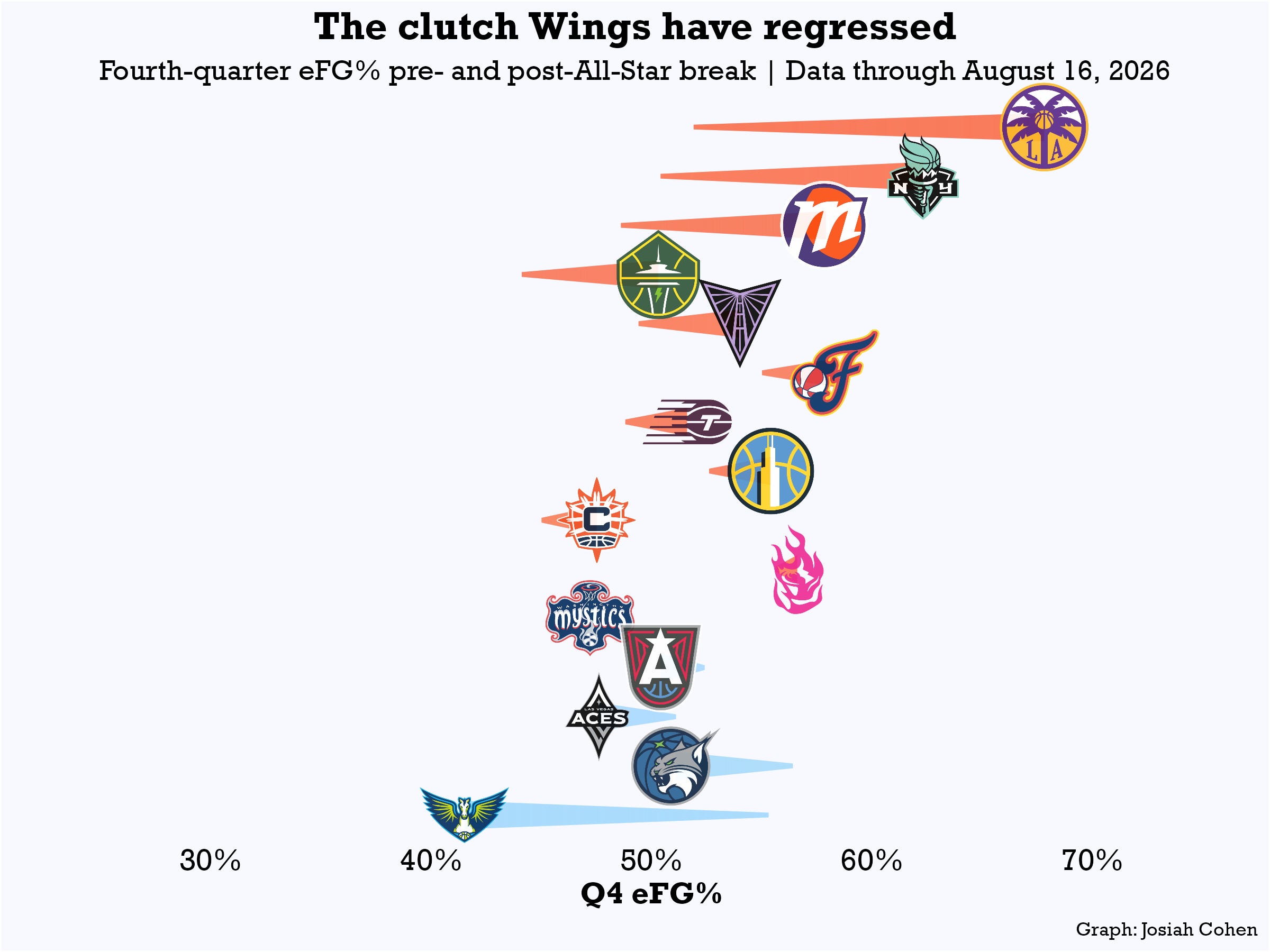
Oh, Dallas. The Wings are 3-7 in their last ten games, slipping to eighth in the standings (Paige Bueckers-Olivia Miles first-round matchup, anyone?) and missing games from Azzi Fudd and Jessica Shepard of late. It’s traceable to the All-Star break and regression (in Alanna Smith’s case, progression) therefrom: since the break, Dallas has a -4.9 net rating, the fifth-worst in the league in that span and by far the worst among the top-eight teams.
It’s hard to pin down exactly what the issue is, besides for playing tough teams (all six losses since the break have been to playoff teams). Looking at Dallas’ four factors, their eFG% is down just 1.8%; their free throw rate is up; their turnover rate is up just 1.6%; and their OREB rate is within 0.2% of the pre-ASB mark. Defensively, their opponent eFG% has actually improved, as has their opponent free throw rate. They are forcing slightly fewer turnovers and conceding more offensive rebounds, but these aren’t huge margins.
I’ll take the blame, actually. At the break, I pointed to Dallas’ success in clutch situations: “Best for Dallas? The offense’s league-leading 60.1% eFG% in clutch situations (last 5 minutes, score +/- 5).” Well, that hasn’t held up: Dallas' is shooting a league-worst 38.1% eFG% since All-Star. It’s a small sample size (just 15 minutes), but if you expand it to fourth quarters as a whole, Dallas’ eFG% has dropped from 55.3% before the break (270 minutes, 3rd best) to 41.5% post-ASB (80 minutes).
On the outside looking in
The Portland Fire (15-20) are five games back of the Wings and probably the only team outside the playoff picture with a hope of getting in. It’ll be a tough, uphill slog for a team that has three games left against Golden State… and a team that will probably see a lot of players play big minutes at the World Cup. They just beat the Kelsey Plum-less Phoenix Mercury (13-23) in dramatic fashion on Diana Taurasi’s jersey retirement night; cutting up that game is my first to-do tomorrow morning, and I’m sure I’ll have thoughts on social. Portland deserves more attention.
The Chicago Sky (13-23) also won yesterday, holding on against the Seattle Storm (7-30). For some reason, as I said earlier, I’ve watched a lot of Sky pick-and-roll defense lately, and I’m sure that’ll be reflected in a standalone article or video at some point. There’s probably no rush to cover it before the playoffs.
The Los Angeles Sparks (12-22) have had some exciting moments recently, despite a four-game losing streak, and Rae Burrell has been a player worth watching. Excitement about the Toronto Tempo can be tempered on the heels of their 10-game losing streak, but one bright spot worth highlighting is Kiki Rice, about whom I wrote for SB Nation’s Raptors HQ. A teaser:
Rice doesn’t sacrifice team defence for the sake of individual matchups. She is happily switchable and, with an extremely high motor and degree of competitiveness on both sides of the ball, a player who projects as a defensive leader for many seasons to come. With great defensive instincts off the ball, Rice can shut down offensive advantages both by rotation and by creating turnovers.
Look at her tremendous rotation: with Rice trailing, Bueckers curls around the screen in Dallas’ pistol action. Toronto rotates to stop the ball in the paint, but does so from both the low and high help points, leaving two players open on the weakside. Bueckers makes the read, but Rice not only sees the read immediately, but also anticipates Alanna Smith’s extra pass and slices out to take away both weakside options (with a tidy closeout to polish it off, too).
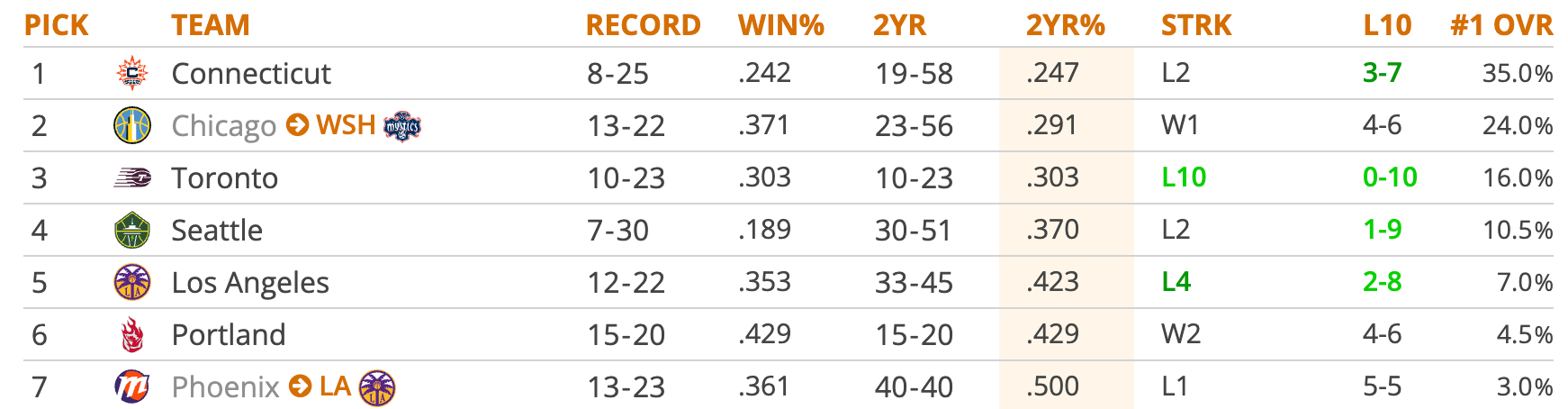
Here’s a look at the current lottery standings, which you can simulate for yourself on Tankathon. Lottery odds are a guess until announced by the league.
Go crazy? Don’t mind if the New York Liberty subreddit does.
1) NaLyssa Smith, shockingly, is vastly improved defensively. She was abysmal when she got into the league; now she's just bad. It's amazing that a good player can be so bad at one part of the game -- but then again, look at Angel Reese.
2) The Indiana 2-3 zone was not very good, but without Canada, Atlanta really couldn't do much. On one possession, the forward went to the wing three-point line, leaving Reese all alone under the hoop, but the guard -- not being Canada -- didn't exploit it.
3) Chicago is clueless. No Stokes and no Salaun last week meant the Valkyries had no inside presence. (In fact, Kayla Thornton was guarding Cardoso at one point.) So where were Cardoso and Elizabeth Williams in the first half? Setting screens for the Sky's non-shooters at the three-point line, and rolling to the hoop as the shot clock expired.
Just a question for Tyler Marsh: With no Stokes, what would have happened if Cardoso just posted up every time and you threw her the ball where only she could catch it? Could anyone guard her? And Azure Stevens was taller than anyone on the Valkyries, so she would have been a force on the offensive boards. I really couldn't believe a professional coach would miss something so obvious ... but then again ....